
Hellenic SteamPunk
Industrial Revolution 1700 years early

When we talk of Industrial age we think of the 18th century AD; what if I told you that Hellenistic Greeks came very close to it 1700 years earlier?
In Alexandria, Greeks had advanced hydraulics, magnetic and automatic tech and even a jet propulsion system; here’s the Hellenistic Steampunk story..
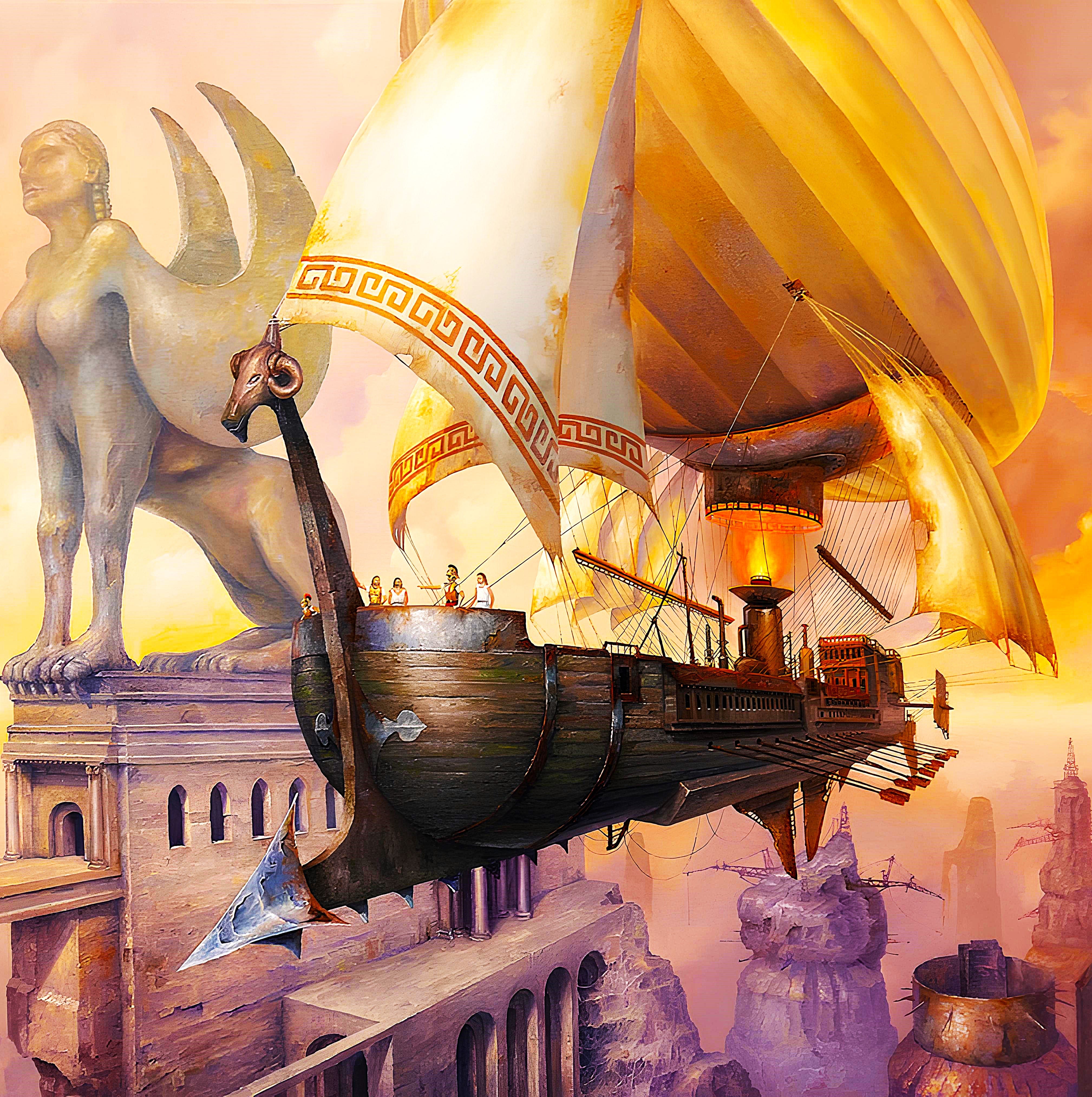
We shall focus specifically on Alexandria; founded by Alexander the Great in 331 BC, Alexandria was a planned metropolis on Egypt’s Mediterranean coast, where the Nile Delta met the sea.
By the Hellenistic period, under the rule of the Greek Ptolemaic dynasty, it had grown into one of the largest and most influential cities in the ancient world, rivaling Athens and later Rome.

Alexandria was a masterpiece of urban design, with a grid layout planned by architect Dinocrates and Alexander himself. Wide boulevards, like the Canopic Way, bustled with activity, lined with marble colonnades, statues, and palm trees.

The city’s centerpiece was the Lighthouse of Pharos, one of the Seven Wonders, its beacon guiding ships into the bustling Great Harbor.
Alexandria was a melting pot of Greek, Egyptian, Jewish, Persian, and other cultures. Greek was the lingua franca, but you’d hear Egyptian, Aramaic, and Hebrew in the markets. Temples to Greek gods like Zeus stood alongside those to Egyptian deities like Serapis, a syncretic god created by the Ptolemies to unite their subjects.
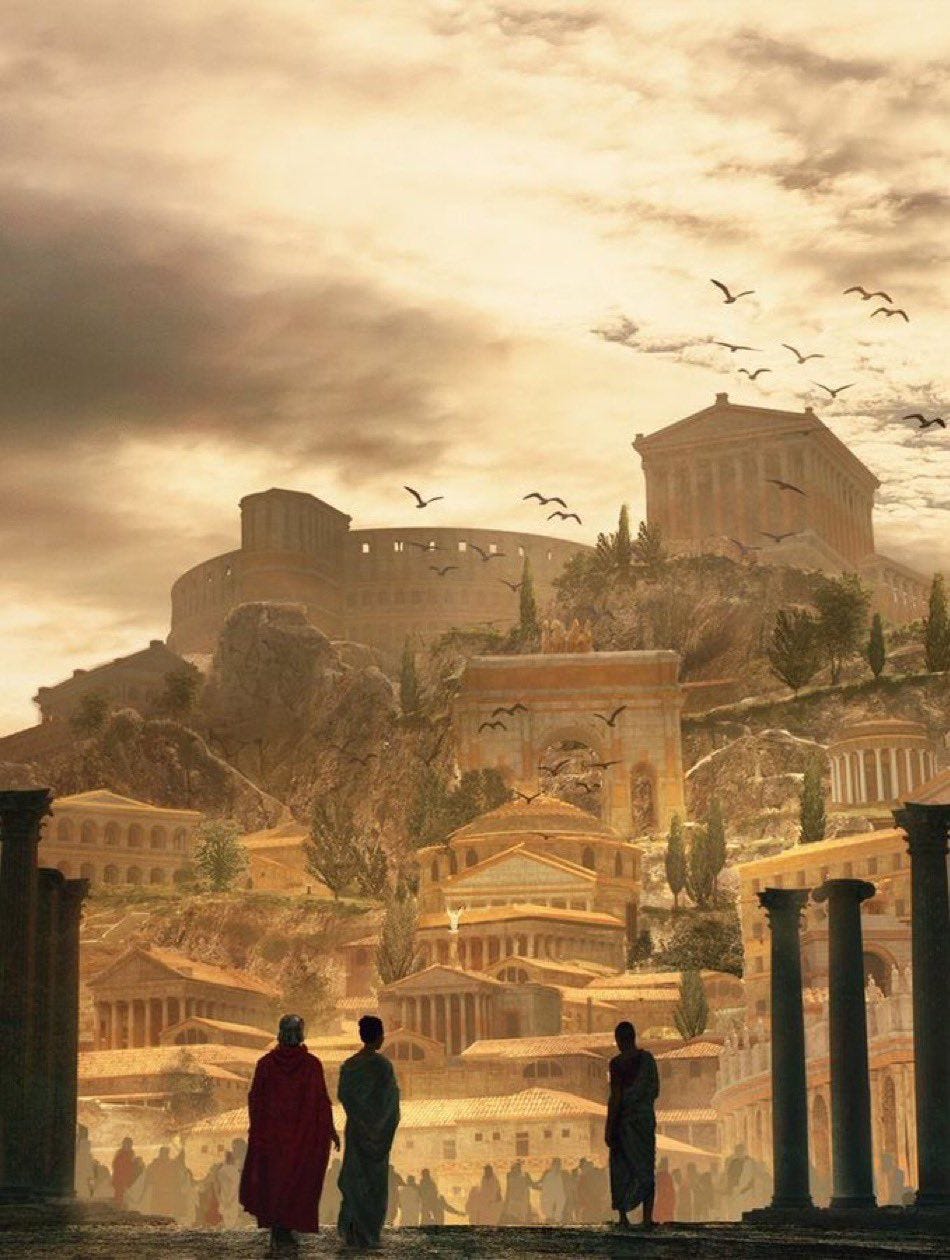
The Ptolemies, descendants of Alexander’s general Ptolemy I, ruled Egypt as Greek pharaohs. They invested heavily in Alexandria’s grandeur to legitimize their dynasty, funding the Library, Lighthouse, and scientific endeavors. However, their focus was on prestige, not industrialization.

This was a scholarly haven where thinkers like Euclid, Archimedes, Eratosthenes, and later Hero of Alexandria worked. Imagine a sprawling campus with lecture halls, laboratories, and gardens where mathematicians debated geometry, astronomers mapped the stars, and engineers like Hero tinkered with steam and pneumatics. The Mouseion attracted the brightest minds, supported by royal stipends.

Housing hundreds of thousands of scrolls, it was the largest repository of knowledge in the ancient world. Librarians like Callimachus cataloged texts on everything from poetry to mechanics. Scholars could access works by Aristotle, Egyptian priests, or Babylonian astronomers, fueling cross-disciplinary innovation.
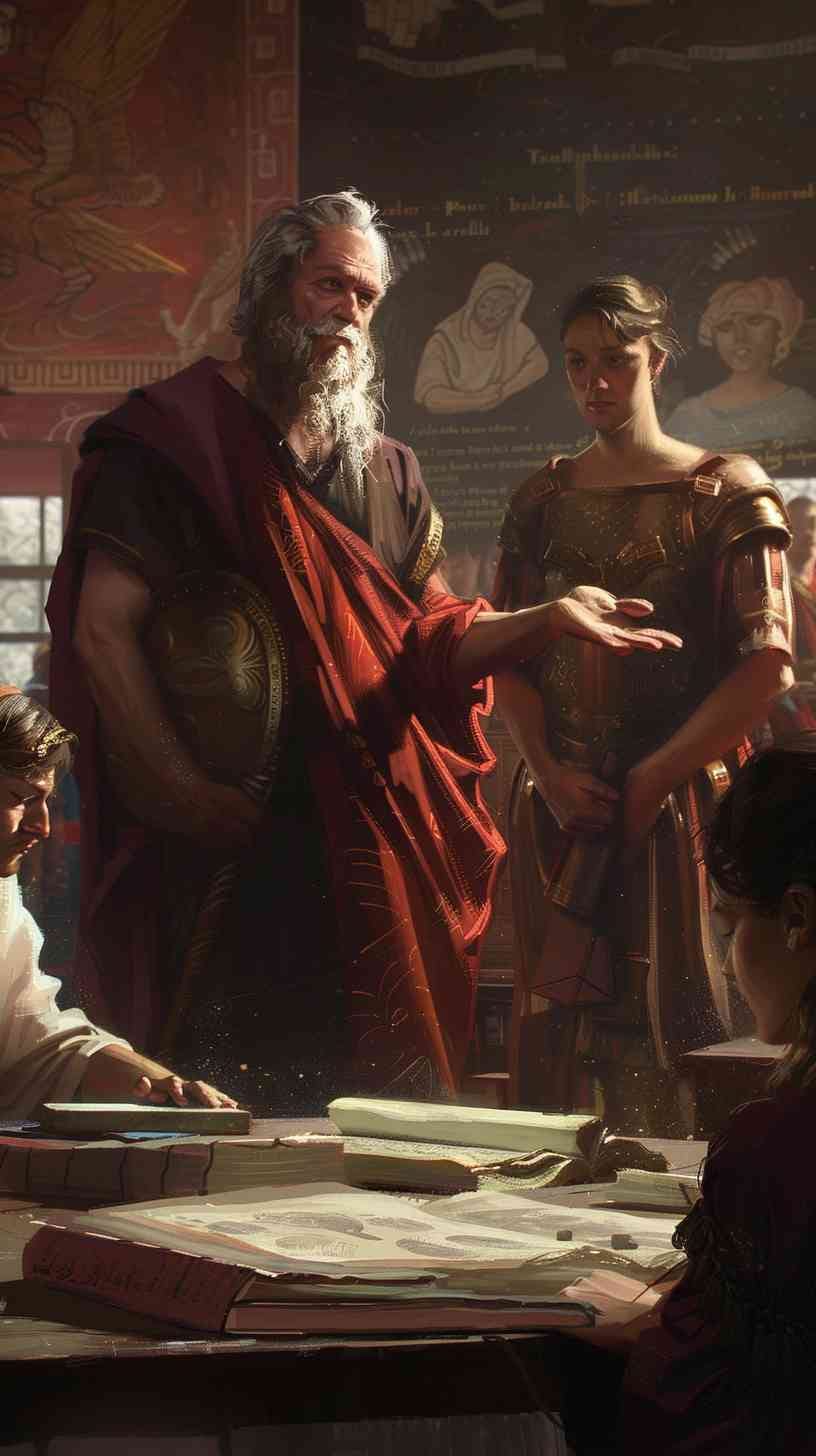
Picture scholars in linen tunics, scribbling on papyrus under flickering oil lamps, or debating in shaded courtyards. The air hummed with ideas—Eratosthenes measuring the Earth’s circumference, Ctesibius inventing water clocks, or Hero sketching his automata.
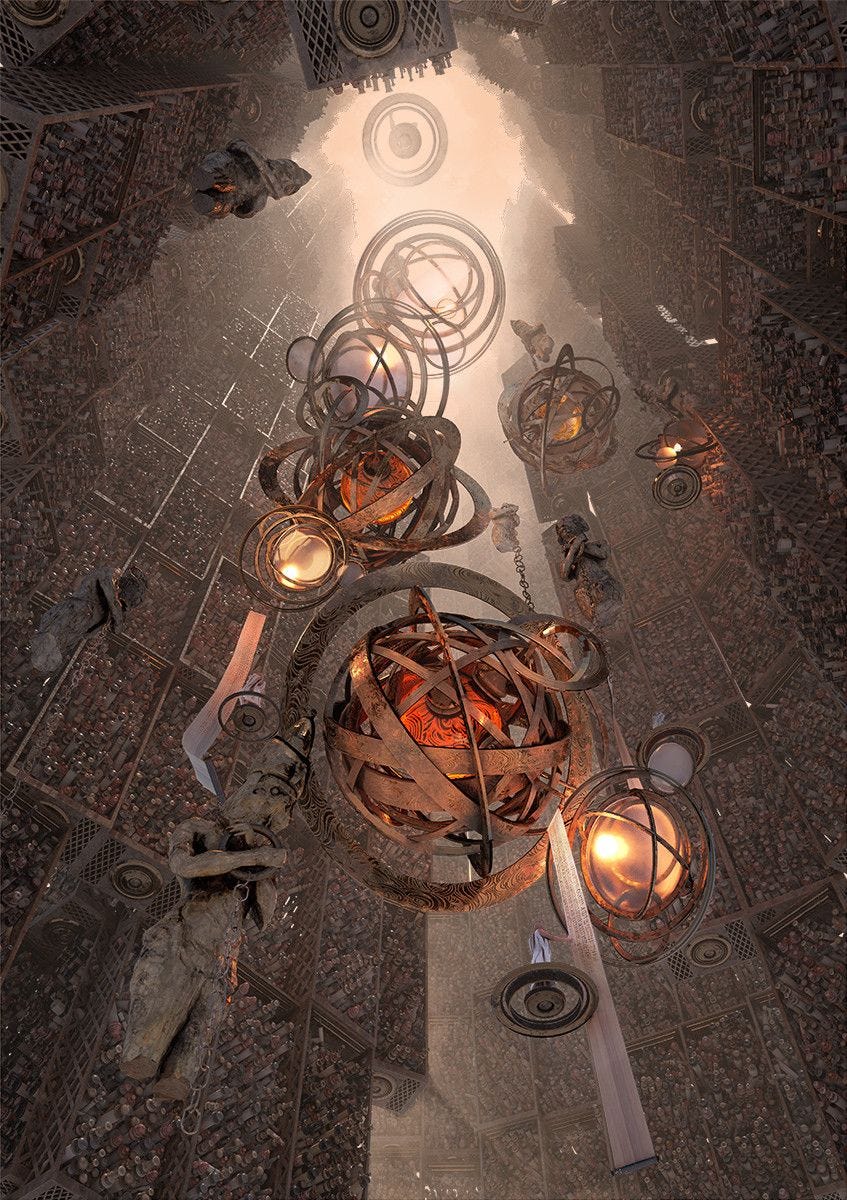
Temples, like the Serapeum (dedicated to Serapis), were stages for technological showmanship. Priests and engineers collaborated to create “miracles”—automatic doors, moving statues, or fountains powered by pneumatics.
They even had a levitating statue might have been suspended by magnets in such the temple, awing worshippers who attributed it to divine power.

The city was a hotbed of mechanical innovation. Engineers built water pumps, automata, and geared devices like the Antikythera mechanism. Workshops near the harbor crafted bronze and iron tools, while the Mouseion hosted experiments with steam, air pressure, and hydraulics. Hero’s aeolipile likely spun in such a workshop, its steam jets hissing as onlookers marveled.
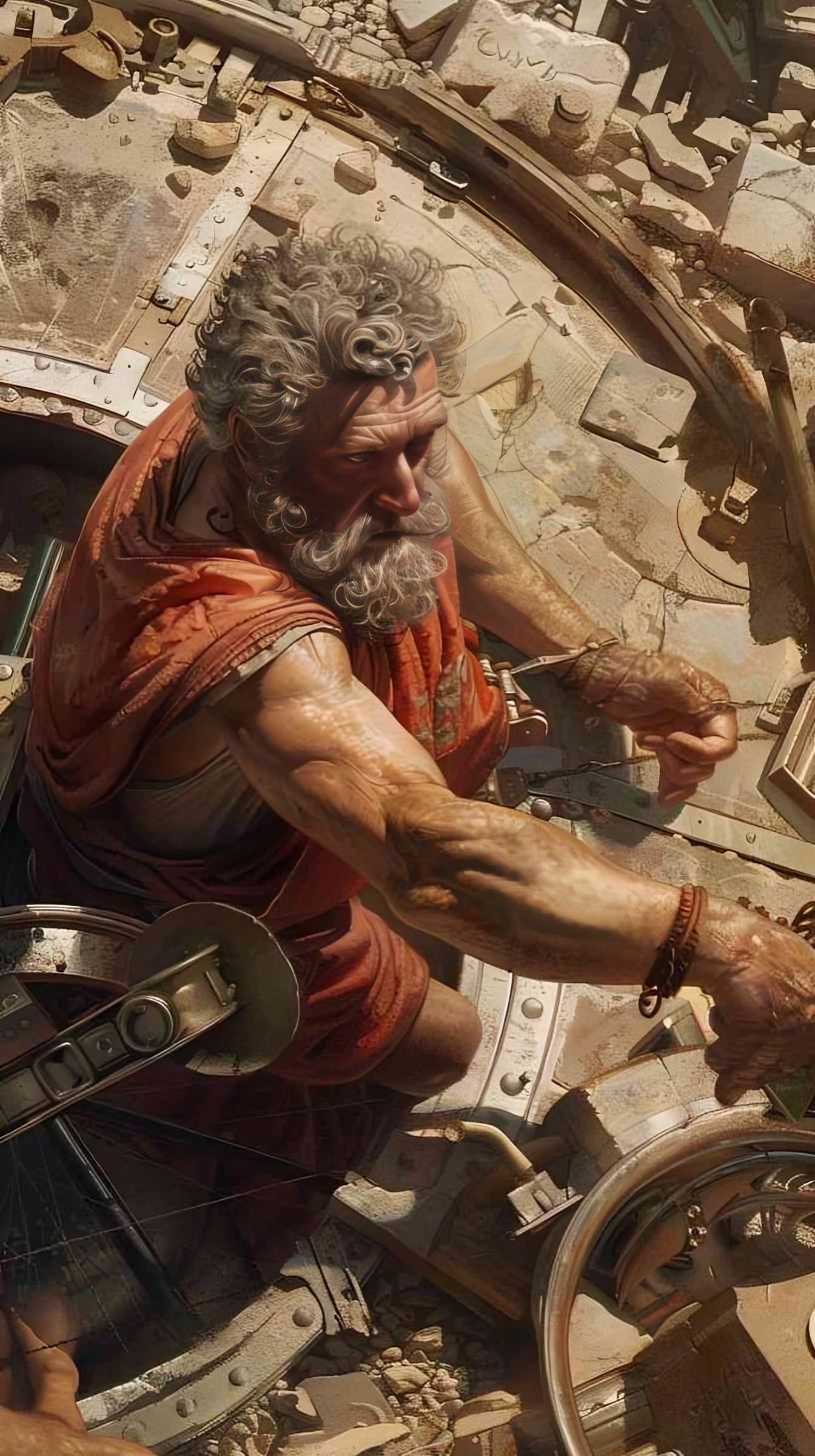
The Hellenistic Greeks were tantalizingly close to an industrial revolution, particularly through the work of Hero of Alexandria (1st century AD), whose aeolipile—a steam-powered rotating sphere—demonstrated the basic principles of steam propulsion.
It was a steam-powered device and one of the earliest known demonstrations of steam propulsion and a remarkable example of ancient Greek engineering. The aeolipile was a simple, steam-driven rotating device, often described as a “steam toy.”

Its design consisted of:
A hollow metal sphere or container filled with water.
Two bent tubes or nozzles protruding from opposite sides of the sphere, angled to create rotational force.
A heat source (e.g., a fire) beneath the sphere to boil the water.
When heated, the water turned to steam, which escaped through the nozzles. The escaping steam created a reactive force (akin to Newton’s third law), causing the sphere to spin on its axis. Essentially, it was a rudimentary jet propulsion system.
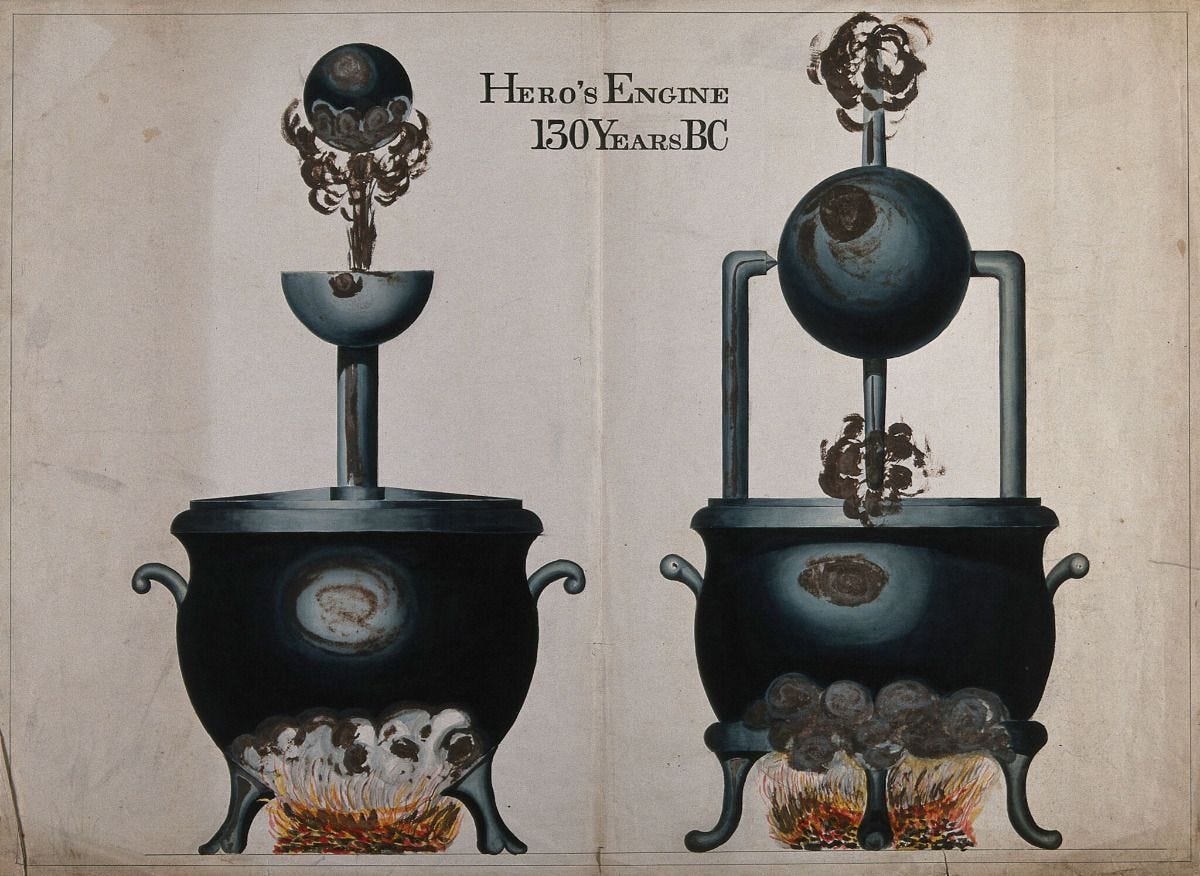
The device showed an understanding of steam’s expansive force and its potential to create mechanical motion—key concepts for later steam engines. It also reflected the Hellenistic Greeks’ advanced knowledge of pneumatics and mechanics.
The aeolipile embodied reactive propulsion (similar to modern rockets or jet engines) and hinted at the conversion of heat energy into mechanical work. However, it lacked components like pistons or gears to translate rotation into useful work.
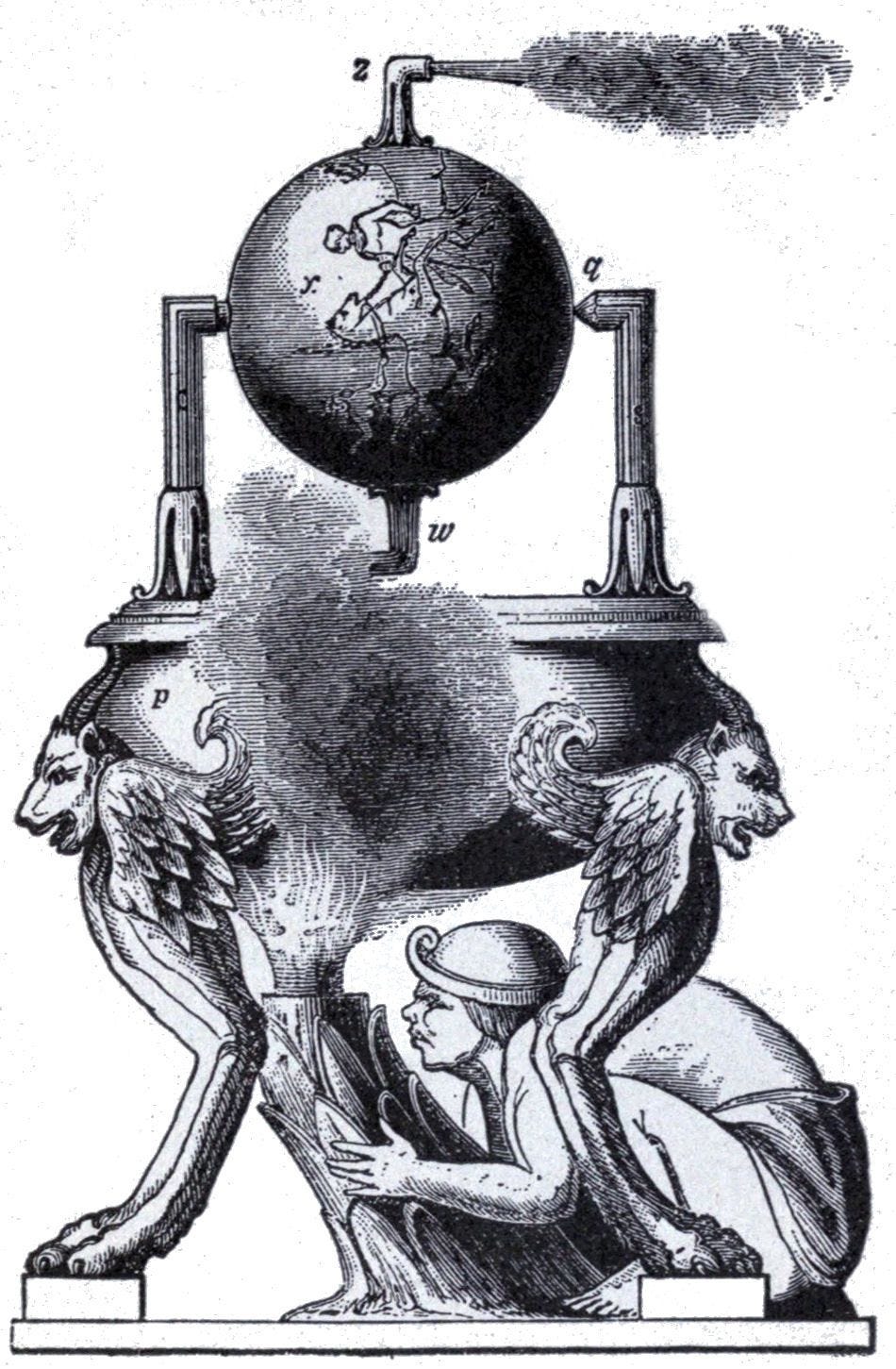
This device showed an understanding of steam’s expansive force and mechanical motion—key principles of a steam engine. It’s arguably the closest any ancient civilization came to harnessing steam power.

Hellenistic Greeks had advanced mathematical and mechanical understanding. Figures like Archimedes and Ctesibius developed sophisticated mechanisms (e.g., water pumps, automata) and understood pressure and pneumatics. Hero’s Pneumatica describes devices using air, water, and steam pressure, indicating a proto-scientific grasp of thermodynamics.

Their engineering was almost unimaginable; i’ll tell you one thing: moving statues and singing bird “robots”. Here’s a few of those mechanical miracles:
1. Theater Marvels: Hero’s Automata describes a mobile theater—a miniature stage on wheels that moved autonomously, powered by falling weights and ropes. It performed entire plays with figurines that danced, fought, or vanished, synchronized by intricate gear systems. These were likely used in festivals to dazzle audiences in Alexandria’s theaters.
